
Documents & practical guidance
Police procedure when someone dies at home
When the police have to be involved in a death at home, what they actually do, and how long it holds up the cremation.
- Official procedure
- Read it in a few minutes
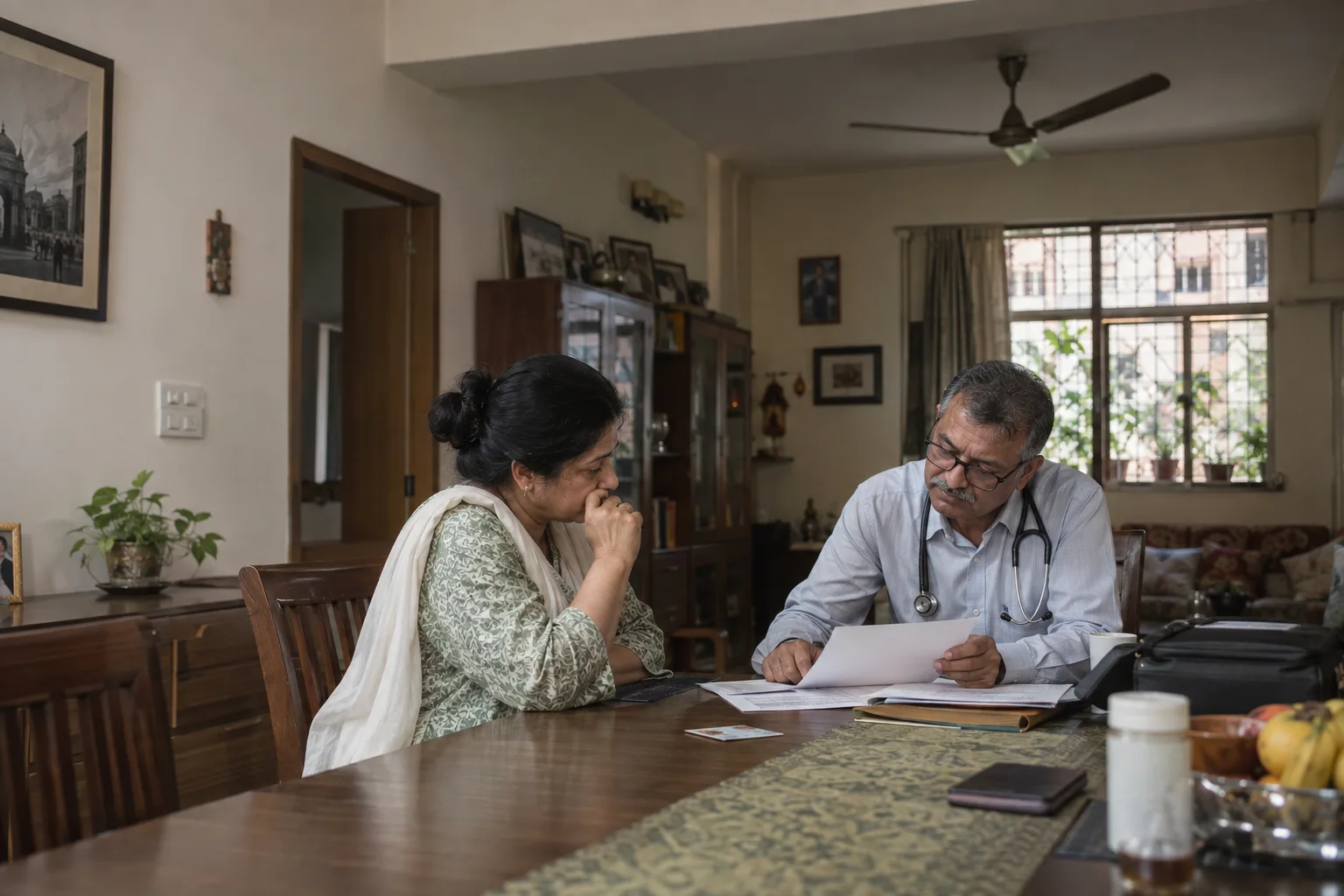
One less thing to work out alone.
The short answer
The police are not involved when someone elderly or ill dies at home under a doctor's care and the death surprises nobody - the treating doctor certifies the cause. Call them at once for any unnatural or unexplained death: accident, suicide, poisoning, burns, a fall, or the death of a woman within seven years of marriage. Dial 112, do not move the body, and keep the DD or FIR number.
The police station in whose jurisdiction the death occurred
Call at once for any unnatural or unexplained death
No fee. Nobody should be asking you for one at any stage
Start here
What to do,
in order.
Work down the list. Each step assumes only that the one above it is done.
-
Decide whether the police need to be called at all
If the person was elderly or ill, was under a doctor's care, and died in a way nobody finds surprising, this is a natural death. The treating doctor certifies the cause and the police are not involved. Call them only where the death is unnatural or unexplained.
-
Call the police for any unnatural or unexplained death
Accident, suicide, poisoning, burns, a fall, any death where the cause is not clear, and any death of a woman within seven years of marriage. Dial 112 or go to the local station. Do not move the body first.
-
A DD entry or an FIR is recorded
For a straightforward unnatural death the station makes a Daily Diary entry. Where a crime is suspected an FIR follows. Either way you get a reference number - write it down, because every later step asks for it.
-
The inquest and the postmortem
A police officer conducts an inquest under Section 194 of the BNSS (formerly Section 174 CrPC) and the body goes for postmortem, normally at a government hospital. This is the step that takes the time, usually the same day if the police surgeon is available.
-
Collect the NOC before arranging the cremation
After the postmortem the police issue a no-objection certificate for the last rites. No crematorium in Delhi will accept an unnatural-death case without it, so collect it before you book anything.
Before you leave the house
What to take
with you.
Gather these once and you will not be sent home for them.
-
Photo ID of the person reporting the death
-
Photo ID of the deceased
-
Any medical records or prescriptions - these often settle the question of whether a death was natural
-
The DD entry or FIR number, at every subsequent step
Why families dread this and why they should not
The police step is the part everyone fears, and in an ordinary unnatural death it is administrative rather than adversarial. A DD entry, an inquest, a postmortem, an NOC. What makes it slow is not suspicion - it is the postmortem queue.
Nobody should be asking you for money
There is no fee at any stage of this process, for the DD entry, the inquest, the postmortem or the NOC.
A little clarity
Common questions
If something here is still unclear, call us - someone answers at any hour.
Do I have to call the police if someone dies at home?
Can we move the body before the police arrive?
How long does a postmortem delay the cremation?
Is a postmortem always required?
Where to go next
Related reading.
The other steps families usually need around this one.
If you would rather not do this yourself
We handle the paperwork.
It is part of every arrangement we make - the registrations, the certificates and the queueing. Ask us what is involved in your case.