
Documents & practical guidance
Documents required for cremation in Delhi
What to carry to the cremation ground, what changes when the death was unnatural, and the one receipt to keep afterwards.
- Official procedure
- Read it in a few minutes
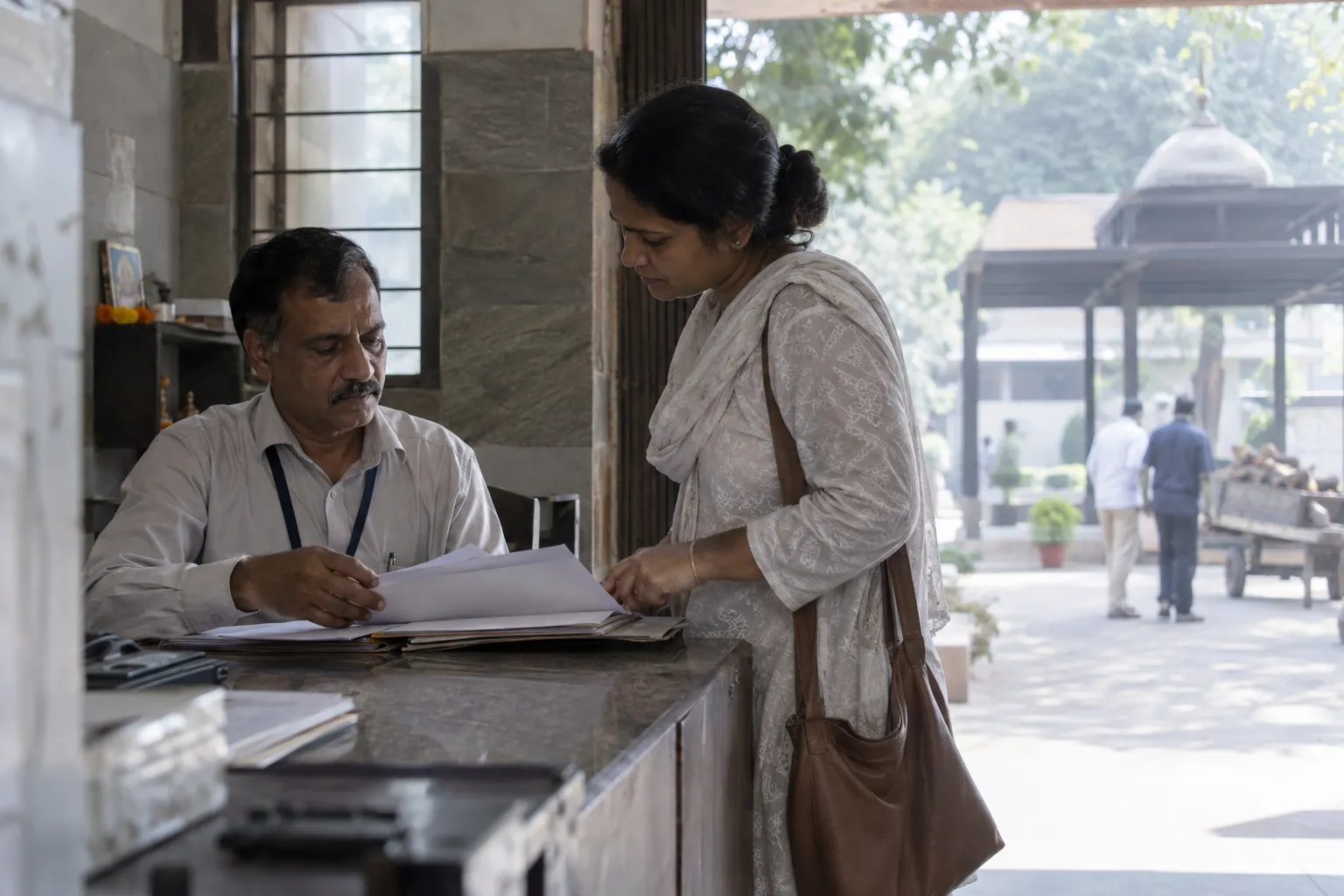
One less thing to work out alone.
The short answer
At a Delhi cremation ground you are asked for the cause-of-death certificate - Form 4 from the hospital, or a doctor's Form 4A for a death at home - and photo ID of the deceased, usually Aadhaar. Carry your own ID too. If the death was unnatural, the ground also needs the police NOC issued after the postmortem. After the cremation the ground gives you a cremation receipt (slip): keep it, because it supports the death registration that must be done within 21 days.
The cremation ground's counter - the MCD for most grounds in Delhi
Carry them to the ground on the day of the cremation
The documents themselves are free; the ground's own charge is paid at its counter
Start here
What to do,
in order.
Work down the list. Each step assumes only that the one above it is done.
-
Get the cause-of-death certificate
For a death in hospital, the hospital issues Form 4, the Medical Certificate of Cause of Death (MCCD). For a death at home, the doctor who was treating the person issues Form 4A. This is the document the ground actually checks - not the final death certificate, which only comes after registration.
-
Carry photo ID - the deceased's and yours
The counter asks for photo ID of the deceased, usually Aadhaar, and of the family member arranging the cremation. If the deceased's Aadhaar cannot be found, carry any government photo ID and ask the counter what it accepts.
-
For an unnatural death, collect the police NOC first
After an accident, suicide, poisoning or any unexplained death, the police conduct an inquest and usually a postmortem. No ground in Delhi will accept the body without the police no-objection certificate, so collect it before you book the cremation.
-
Keep the cremation receipt
After the cremation the ground issues a receipt, often called the cremation slip. Keep the original and a photocopy - it is accepted as a supporting document for the death registration.
-
Register the death within 21 days
Registration is free within 21 days of the death. The hospital usually does it for a hospital death; for a death at home the family applies to the MCD zonal office covering the place of death.
Before you leave the house
What to take
with you.
Gather these once and you will not be sent home for them.
-
Medical Certificate of Cause of Death - Form 4 (hospital) or Form 4A (home)
-
Hospital death summary, for a death in hospital
-
Photo ID of the deceased - usually Aadhaar
-
Photo ID of the family member arranging the cremation
-
Police NOC and postmortem papers, for an unnatural death
The document families confuse most
The Medical Certificate of Cause of Death is what the cremation ground needs. The death certificate comes later, from the MCD, once the death is registered. Families sometimes delay a cremation looking for a death certificate that cannot exist yet. Carry Form 4 or Form 4A instead.
A little clarity
Common questions
If something here is still unclear, call us - someone answers at any hour.
Is a death certificate needed before cremation in Delhi?
What is a cremation slip?
What if the deceased's Aadhaar is not available?
Are the documents different for an unnatural death?
Where to go next
Related reading.
The other steps families usually need around this one.

If you would rather not do this yourself
We handle the paperwork.
It is part of every arrangement we make - the registrations, the certificates and the queueing. Ask us what is involved in your case.