
Documents & practical guidance
Hospital mortuary procedure in Delhi
What happens between a death in a Delhi hospital and the body being released to the family, in the order it actually happens.
- Official procedure
- Read it in a few minutes
One less thing to work out alone.
The short answer
A Delhi hospital releases a body once the ward has issued the death summary and the mortuary has logged it - the same day in most cases, longer if a postmortem is ordered. Whoever claims the body needs photo ID; Aadhaar is accepted everywhere. Government mortuaries are free for the first day or two, while private hospitals charge for storage.
The hospital's mortuary and records department
Same day in most cases; longer if a postmortem is ordered
Free at government hospitals for the first 24-48 hours; private hospitals charge storage
Start here
What to do,
in order.
Work down the list. Each step assumes only that the one above it is done.
-
The ward issues the death summary
The treating doctor records the death and the ward prepares a death summary. This is not the death certificate - it is the hospital's own document, and it is what everything else depends on. Ask for two copies.
-
The body is moved to the mortuary
Porters move the body to the mortuary, usually within an hour or two. In large government hospitals this can take longer at night. The family does not need to be present for it.
-
The MCCD is prepared
The hospital issues Form 4, the Medical Certificate of Cause of Death, and reports the death to the registrar. This is the step that later makes the death certificate possible, so confirm it has been done before you leave.
-
You apply at the records counter to claim the body
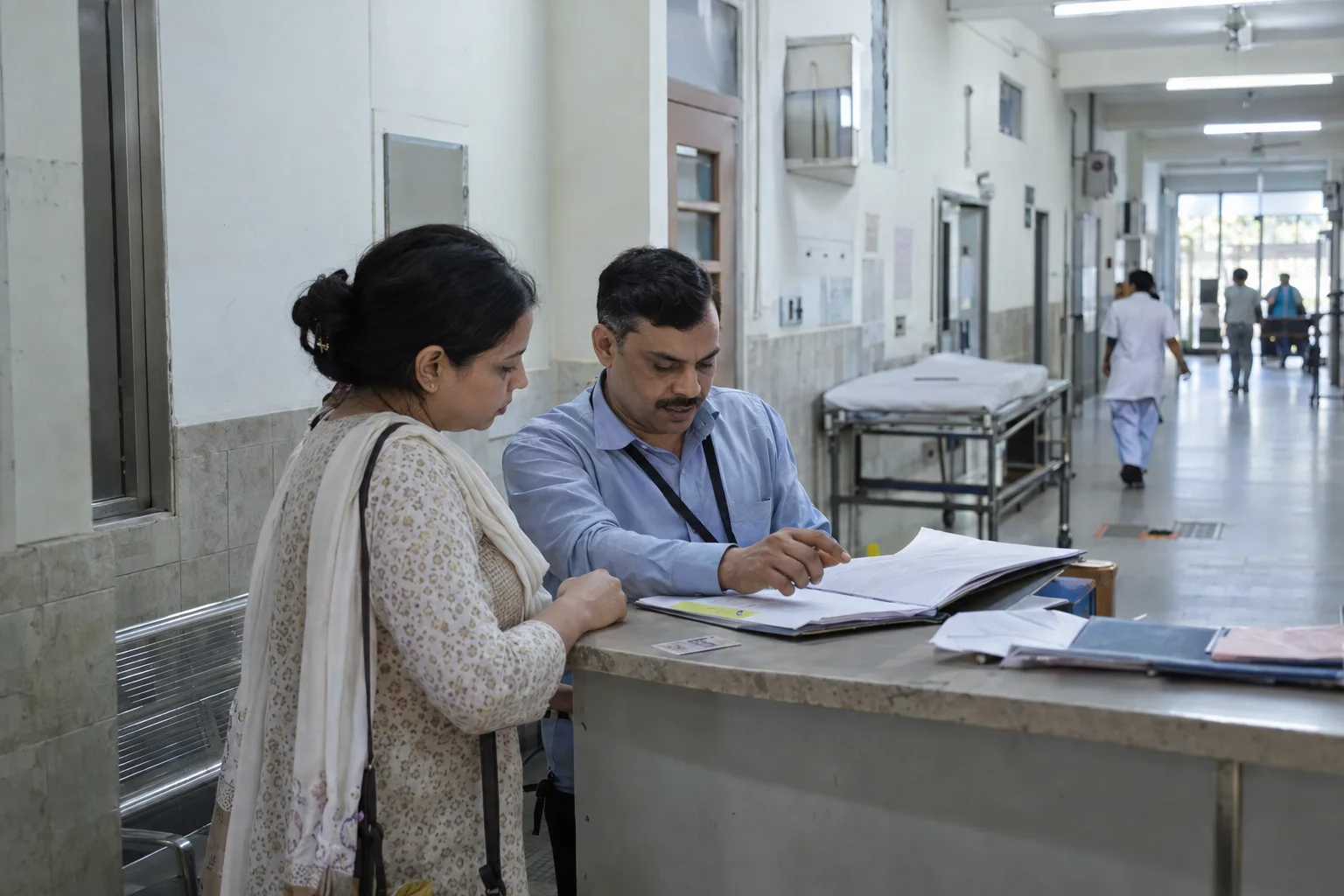
Take the death summary and your own photo ID to the records or mortuary counter. The claimant is normally the next of kin. You sign a release register and the body is handed over.
-
Arrange the vehicle before you claim
Most hospitals will not hold a released body while you find transport, and the mortuary will not release it to a private car. Have the hearse or mortuary van at the gate first.
Before you leave the house
What to take
with you.
Gather these once and you will not be sent home for them.
-
Hospital death summary, or the death intimation slip from the ward
-
Photo ID of the person claiming the body - Aadhaar is accepted everywhere
-
Photo ID of the deceased, if you have it
-
The admission or IP number, which speeds up the records search considerably
Why this page exists
None of the four national funeral services has written this down. Every family that loses someone in a Delhi hospital has to work it out at the counter, at the worst possible moment, usually from a porter who is guessing.
The one thing that goes wrong most often
Families complete the paperwork, then discover the body cannot leave because there is no vehicle. Arrange transport first. It costs nothing to have a van waiting and it saves an hour of standing in a corridor.
A little clarity
Common questions
If something here is still unclear, call us - someone answers at any hour.
Who can claim a body from a hospital mortuary in Delhi?
How long can a hospital hold the body?
Can I take the body in my own car?
What if a postmortem is ordered?
Where to go next
Related reading.
The other steps families usually need around this one.

If you would rather not do this yourself
We handle the paperwork.
It is part of every arrangement we make - the registrations, the certificates and the queueing. Ask us what is involved in your case.